
Small knotless braids in San Diego turn many carefully sized sections into a refined protective style where braid consistency, detailed parting, chosen length, and extension color work together throughout the finished look.

With smaller braids, consistency becomes noticeable because the same technique is repeated across many sections. A slight difference in braid width, part size, or extension distribution can stand out once it appears beside dozens of neighboring braids. That makes fine sectioning less about creating the smallest possible braid and more about keeping the complete set visually coordinated from hairline to crown and through the lengths.
Clients choosing small knotless braids in San Diego may also notice that length and color become increasingly important as the braid count rises. A single contrasting braid has little effect, while repeated color placement can change the appearance of the entire style. Mid-back and longer lengths also extend that detailed pattern farther beyond the shoulders. Awa Hair Braiding can discuss small braid length selection, extension color blending, fine parting, and preferred finished density while keeping each choice connected to the overall appearance rather than treating each detail separately.
Small braid work gives clients a highly detailed finish where consistency across many sections can influence the overall polish, length, density, and color distribution.
When many braids appear together, uneven widths become easier to notice. Consistent sizing helps each braid contribute to a more coordinated finished appearance across the set.
Small, detailed braid sections require repeated parting decisions, making spacing important wherever the scalp remains visible between neighboring braids along the hairline, crown, and sides.
A higher braid count can create a visually fuller field of individual braids, so density should reflect the intended finish rather than simply maximizing section numbers.
Longer fine braids extend the visual pattern farther down the body, making the selected drop point an important part of how the completed hairstyle is perceived.
Smaller braids can spread extension shades across many individual pieces, allowing subtle blending or repeated contrast to influence the entire look without changing braid dimensions.
The salon's African hair braiding specialists work across numerous braid formats, bringing detailed sectioning experience to clients who prefer a finer knotless braid scale.
Your appointment can establish braid dimensions, section placement, finished length, color direction, and the density preferred across the completed hairstyle.
From fine, fragile hair to thick, coarse textures, the technique adjusts to what your hair needs.
The process repeats carefully planned sizing from section to section, carrying the selected braid dimensions, color direction, and length throughout the hairstyle.
Agree on the preferred small braid dimensions.
Create fine sections across the planned layout.
Continue consistent braid formation through each section.
Review braid sizing, length, density, and appearance.
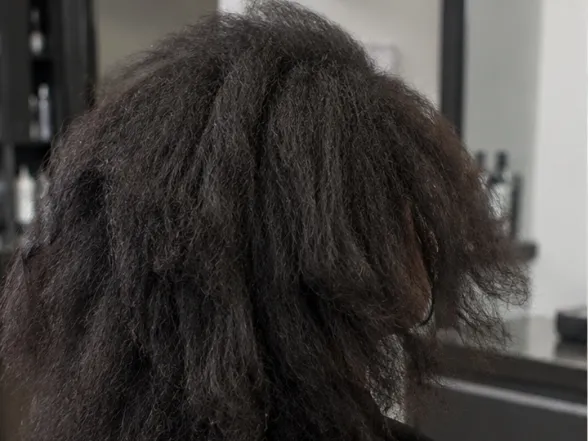
Before — natural hair, pre-appointment
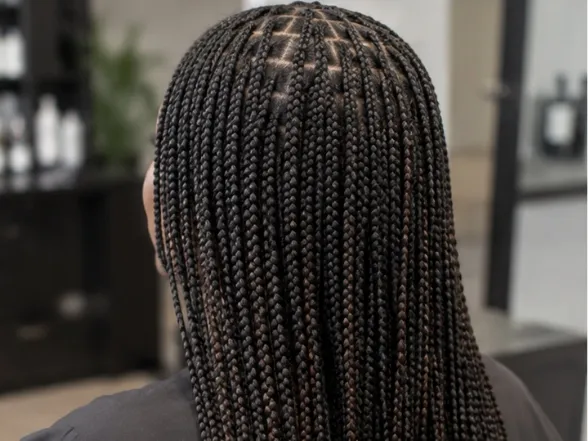
After — finished small knotless braids
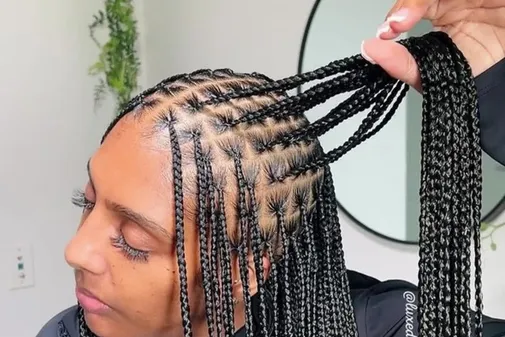
Small braid sizing creates a very different overall appearance from wider knotless options. Compare how much individual definition, scalp detail, and repeated color you want before settling on the final scale. Clients exploring hair styling services in North Park can use reference images to clearly explain their preferred proportions.
Browse examples featuring fine braid widths, varied lengths, color placement, section detail, and different finished densities.

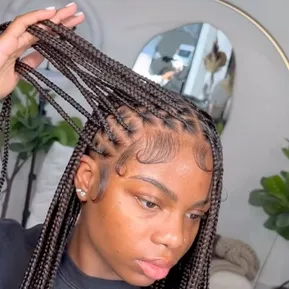
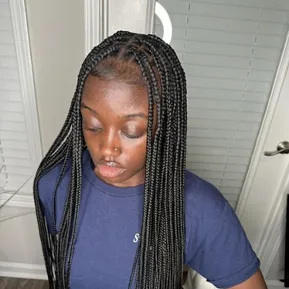
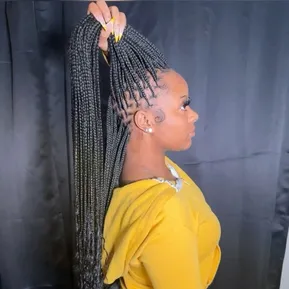
Smaller braids require more individual sections, so the parting pattern repeats across a larger portion of the scalp. Consistent spacing can make the complete style appear more organized, while the exact pattern still depends on the chosen braid size and desired density.
Smaller sections generally produce more individual braids, but visual density also depends on head shape, parting, extension quantity, and braid placement. A client can prefer fine braids without necessarily wanting the fullest possible result, so density should be discussed separately from size.
Longer small braids extend the fine repeated pattern farther down the body and can change the overall proportions of the hairstyle. Clients considering waist-length knotless braids should discuss extension requirements, preferred density, and the amount of length they actually want.
No universal measurement defines small knotless braids across every salon. One stylist’s small category may differ from another’s, which is why reference photos are useful. Clients should confirm expected section size, braid width, and finished density before the appointment begins.
Medium braids may suit someone wanting fewer sections and more visible individual braid width. Clients comparing small sizing with mid-back medium knotless braids should consider braid count, scalp visibility, desired detail, finished length, and the overall visual density they prefer.
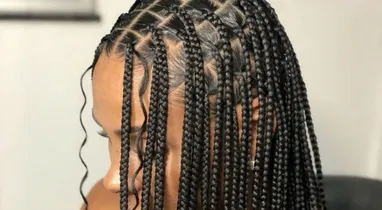
Choose broader sections with less fine repetition.
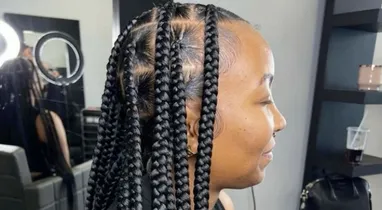
Move toward wider braids and fewer sections.

Extend fine braid detail through added length.
Choose your preferred braid scale, length, density, and color direction with Awa Hair Braiding.